
Most people think a shed is just a box, but if you don’t add a vent, it turns into a mold factory in the winter. I learned this when I opened my shed after a snowy season and found my lawnmower seat covered in mildew.
If you live in a climate with humidity, rain, snow, or big temperature swings, your 10×12 shed will trap moisture fast — and that’s what ruins most sheds long before the structure wears out. This guide explains exactly how to ventilate and protect a 10×12 shed so it stays dry, odor-free, and long-lasting.
For step-by-step building instructions, diagrams, and free downloadable PDFs, visit>>
Why Ventilation Matters (Real-World Problems It Prevents)
A 10×12 shed is small enough that moisture builds up quickly. Without airflow, you’ll start seeing:
🚧 Planning Your Next Build?
Don't start without the Ultimate Guide: Barns, Sheds & Outbuildings. It’s the "DIY Bible" containing:
- 100+ Plans: Barns, sheds, garages, and playhouses.
- Step-by-Step: Covers foundations, framing, wiring, and roofing.
- Blueprints: Includes info on ordering CAD files.
As an Amazon Associate, I earn from qualifying purchases at no extra cost to you.
- Musty odor or mold on walls
- Rusty tools and equipment
- Damp floor or soft plywood spots
- Warped siding or roof panels
- Dripping condensation on cold mornings
- Mildew on stored items
This happens in every region — but it’s worse in:
- Humid states (FL, GA, SC, TX)
- Rainy climates (WA, OR, BC)
- Snow-heavy zones (MN, WI, MI)
- Coastal states (NC, VA, MA, CA)
Good ventilation stops all of this.
⚠️ Avoid Lumber Waste

Don't guess measurements! Get the exact cutting list and step-by-step blueprints for this 10x12 build.
As an Amazon Associate, I earn from qualifying purchases. This helps support our free DIY guides at no extra cost to you.
The 6 Best Ventilation Options for a 10×12 Shed
These are proven to work across the US, Canada, and UK climates.
1. Gable Vents (Simple & Effective)
Installed at the top of the front and back walls.
Best for: Most 10×12 residential sheds.
Why they work: Warm air rises and escapes naturally.
2. Ridge Vent (Top Recommended for Gable Roofs)
Runs along the entire roof peak.
Best for: States with heat and humidity (TX, FL, CA, GA).
Why it works: Continuous airflow + low maintenance.
3. Soffit Vents (Perfect Intake System)
Installed under roof overhangs.
Best when paired with a ridge vent.
Pulls cool air in → pushes hot air out.
4. Turbine Vent (Wind-Powered)
Spins and sucks air out.
Best for: Hot, coastal, or windy regions.
Great for metal and shingle roofs.
5. Windows (Cross Ventilation + Natural Light)
Adding one or two operable windows drastically improves airflow.
Great for: Garden sheds, workshops, hobby spaces.
⚠️ Avoid Lumber Waste
Don't guess measurements! Get the exact cutting list and step-by-step blueprints for this 10x12 build.
As an Amazon Associate, I earn from qualifying purchases. This helps support our free DIY guides at no extra cost to you.
6. Louvered Wall Vents
Simple, durable, and resistant to rain.
Great for: Sheds with limited wall space.
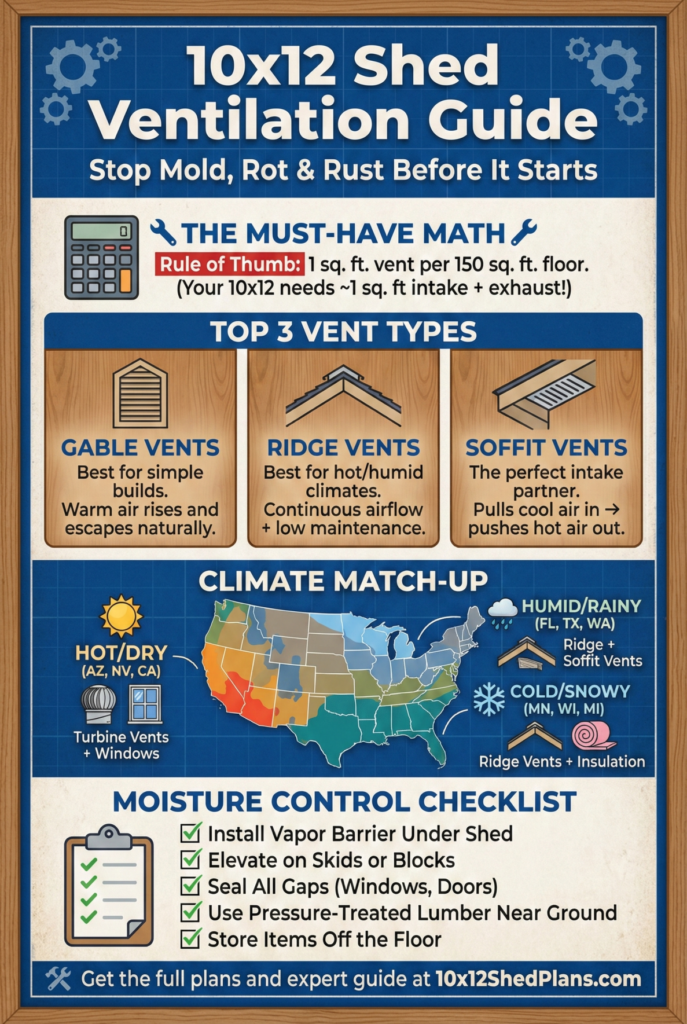
How Much Ventilation Does a 10×12 Shed Actually Need?
The general building guideline:
1 sq ft of vent area per 150 sq ft of shed floor space.
Your 10×12 shed = 120 sq ft → Needs about 1 sq ft intake + 1 sq ft exhaust.
Most effective setup:
- Two gable vents OR
- Ridge vent + soffit vents
Moisture Control Strategies (Equally Important!)
Ventilation alone isn’t enough — you must control moisture sources.
1. Vapor Barrier Under the Shed
Add a plastic moisture barrier under gravel pads.
Stops ground moisture from rising into the shed floor.
2. Elevate the Shed Properly
Use skids or blocks. Never sit the shed straight on soil.
3. Use Pressure-Treated Lumber Near Ground
Prevents rot and mold.
4. Install Drip Edge
Protects roof edges from rain intrusion.
5. Seal All Gaps
Caulk around windows, doors, and trim.
6. Add Underlayment Under Roofing
Roofing felt or synthetic underlayment prevents condensation.
7. Store Items Off the Floor
Use shelves, wall hooks, or pallets.
Best Ventilation Setup by Climate (Geo-Optimized)
Humid Climates (Florida, Georgia, Texas)
- Ridge vent + soffit vents
- Optional turbine vent
Cold/Snow States (Minnesota, Wisconsin, Michigan)
- Ridge vent
- Strong insulation
- Underlayment essential
Rainy Coastal Regions (Washington, Oregon, UK)
- Gable vents
- Louvered vents
- Metal roofing recommended
Dry/Hot Areas (Arizona, Nevada, California)
- Turbine vent
- One operable window
- Reflective roofing helps
Common Ventilation Mistakes to Avoid
These mistakes lead to expensive damage:
- Blocking vents with insulation
- Forgetting ridge or soffit vents
- Installing only intake vents (no exhaust)
- No underlayment under shingles
- Sealing the shed too tightly
Final Thoughts
A 10×12 shed stays dry, fresh, and long-lasting only when it has proper airflow + moisture control. Whether you’re building a workshop, garden shed, or storage shed, ventilation is just as important as framing or roofing.
For free downloadable 10×12 shed plans and a complete building walkthrough, visit: