
If you want stronger, cleaner, and safer woodworking projects—whether you are framing a 10×12 shed, building custom doors, or setting up a heavy-duty workbench—the type of joint you use matters. Choosing the right joint improves structural strength, longevity, and finish quality.
This guide covers the most important woodworking joints, when to use them, and how to choose the right one for your build.
What Are Woodworking Joints?
Woodworking joints are methods used to connect two or more pieces of wood. Good joints:
- Improve structural integrity
- Reduce reliance on visible fasteners
- Increase weather resistance and durability
- Enhance overall appearance
The 15 Joints
1. Butt Joint
🚧 Planning Your Next Build?
Don't start without the Ultimate Guide: Barns, Sheds & Outbuildings. It’s the "DIY Bible" containing:
- 100+ Plans: Barns, sheds, garages, and playhouses.
- Step-by-Step: Covers foundations, framing, wiring, and roofing.
- Blueprints: Included bonus CAD files
The simplest joint where the end of one board meets another.
- Best for: Quick builds, shed wall framing, stud work.
- Strength: Low (requires structural screws, nails, or metal brackets).
2. Miter Joint
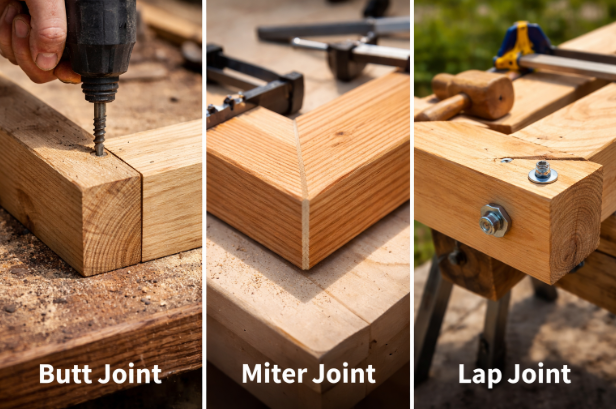
Two pieces joined at an angle (usually 45°).
- Best for: Window trims, door casings, decorative frames.
- Strength: Moderate (needs reinforcement).
3. Lap Joint
Two boards overlap partially, with material removed from both to sit flush.
- Best for: Shed roof trusses, heavy structural frames.
- Strength: Strong and easy to assemble.
4. Dovetail Joint
Interlocking wedge-shaped cuts.
- Best for: Drawers, premium furniture, toolboxes.
- Strength: Very high (resists being pulled apart).
5. Dado Joint
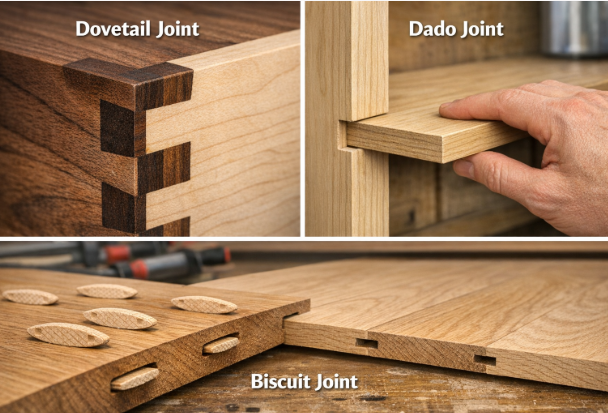
A groove cut across the grain that holds another board.
- Best for: Heavy-duty shed shelving, cabinets.
- Strength: Strong (supports heavy downward loads).
6. Biscuit Joint
Oval wooden “biscuits” glued into matching slots for alignment.
- Best for: Panel joining, aligning tabletops.
- Strength: Moderate.
7. Dowel Joint
Wooden pins glued and inserted into matching holes.
- Best for: Furniture, reinforcing frames without visible screws.
- Strength: Strong.
8. Pocket Joint
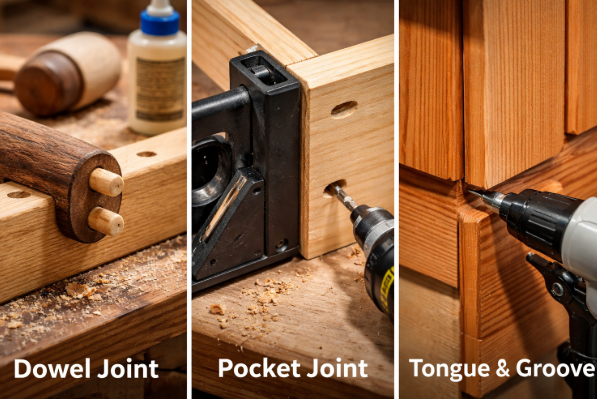
Angled screws driven through one board into another.
- Best for: Fast DIY builds, shed workbenches, jigs.
- Strength: Strong and quick to assemble.
9. Tongue and Groove
A protruding tongue on one board fits into a groove on another.
- Best for: Shed flooring, exterior siding, paneling.
- Strength: Tight, flat, and stable.
10. Box Joint
Square interlocking fingers glued together.
- Best for: Storage boxes, planters.
- Strength: Strong (large glue surface area).
11. Rabbet Joint
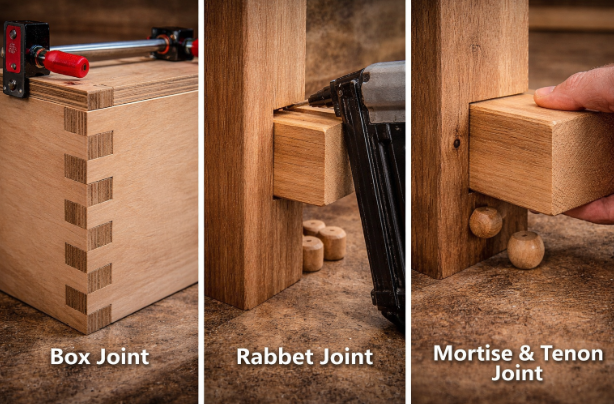
An edge cut that allows another board to sit flush inside it.
- Best for: Cabinet backs, simple window frames.
- Strength: Moderate.
12. Mortise and Tenon
A projecting tenon fits exactly into a mortise hole.
- Best for: Custom shed doors, heavy timber framing, workbenches.
- Strength: Very high (one of the strongest joints in woodworking).
13. Bridle Joint
An open version of the mortise and tenon.
- Best for: Frame corners, robust leg assemblies.
- Strength: Strong.
14. Groove Joint
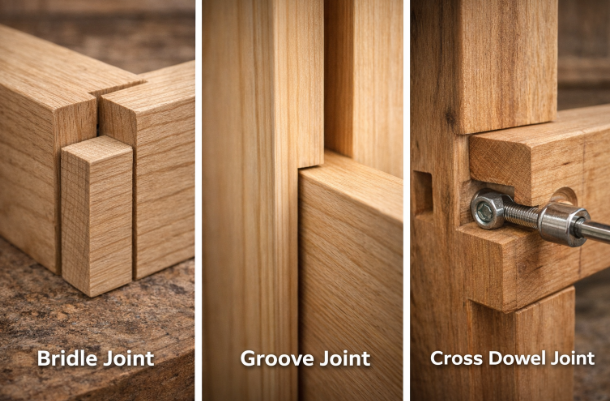
A channel cut along the grain of the board.
- Best for: Drawer bottoms, sliding doors.
- Strength: Moderate.
15. Cross Dowel Joint
A steel bolt intersects a metal dowel (barrel nut) inserted into the wood.
- Best for: Knock-down workbenches, heavy furniture, utility racks.
- Strength: Very strong.
How to Choose the Right Joint
- For rough framing & sheds: Butt, Lap, Pocket
- For doors & heavy frames: Mortise & Tenon, Lap
- For shelving & cabinets: Dado, Rabbet
- For siding & flooring: Tongue & Groove
Common Mistakes to Avoid
- Using weak joints for heavy structural loads (e.g., using miter joints for a workbench).
- Skipping outdoor-rated wood glue on exterior projects.
- Poor measurements resulting in loose fits.
- Misalignment during the glue-up and clamping process.
Some Of My Handpicked Tools Required for Woodworking Projects
You do not need a professional workshop, but a few reliable, heavy-duty essentials are a must for accurate framing and long-term maintenance. Here is exactly what I recommend to get the job done right.
As an Amazon Associate, I earn from qualifying purchases. This helps support our free DIY guides at no extra cost to you.
Power Tools & Safety Gear
Safety First: Proper protection is non-negotiable. Always use safety glasses and ear protection when operating power saws and drills.
- Circular Saw: DEWALT DWE575SB (The professional’s choice)
- Power Drill / Driver: DEWALT 20V MAX Drill Driver Kit (Best value)
- Speed Square: Swanson S0101 (The industry standard)
- 4-Foot Level: Stanley FATMAX (Ensures straight walls)
- Claw Hammer: Estwing E3-16C Steel Hammer
- Safety Glasses: 3M Virtua CCS Anti-Fog
- Work Gloves: Mechanix Wear The Original
- Ear Protection: 3M Peltor X5A Earmuffs
Frequently Asked Questions
What is the strongest woodworking joint?
The mortise-and-tenon and dovetail joints are considered the strongest due to their mechanical interlocking design and massive glue surface area.
Which woodworking joint is best for beginners?
Butt joints, pocket joints, and lap joints are the easiest to learn, require minimal specialized tools, and are highly practical for utility builds.
Do you need glue for wood joints?
Yes. Wood glue significantly increases strength and rigidity, even when structural screws or nails are used. For sheds, ensure you use a waterproof or water-resistant glue.
What joint is best for heavy framing or furniture?
Mortise and tenon, cross dowel, and lap joints are ideal for bearing heavy weight and long-term use.
What is the easiest strong wood joint?
The pocket joint is one of the easiest and strongest options for beginners building utility projects.
Are screws better than wood joints?
Screws are fast and excellent for framing, but proper mechanical joints (like lap or dado joints) combined with glue create stronger, load-bearing connections that won’t loosen over time.
What joint is used for heavy-duty shelves?
Dado joints are highly recommended because the shelf rests completely on the wood of the upright, providing immense downward support.
What is the difference between a dado and a groove joint?
A dado is cut across the wood grain, while a groove is cut along the grain.
Which joint is best for cabinets?
Dado and rabbet joints are the industry standard for constructing durable cabinet boxes.
Can beginners make dovetail or mortise joints?
Yes, but they require practice, patience and sharp chisels or routers. Many builders start with simpler lap and pocket joints before moving up.
Final Thoughts
Solid construction isn’t about owning the most expensive tools—it’s about matching the right joint to the structural demands of your project. Start with the basics, build sturdy frames, and let the results speak for themselves.