
If you’ve spent any amount of time in a woodshop, you already know the golden rule: a woodworking project is only as strong as its weakest joint. You can spend hours selecting the perfect rough-sawn lumber, milling it square, and cutting flawless dovetails, but if you reach for the wrong bottle of glue, all that hard work can literally fall apart.
Walking down the adhesive aisle at your local hardware store can be overwhelming. From traditional hide glues to modern two-part epoxies, the options seem endless. But here is the truth: there is no single “best” wood glue. There is only the right glue for your specific project. In this comprehensive guide, we are going to break down the 10 most common types of wood glue, rank their strength, and give you a bulletproof cheat sheet on exactly when to use what. Because at the end of the day, the right glue = stronger work + longer-lasting projects
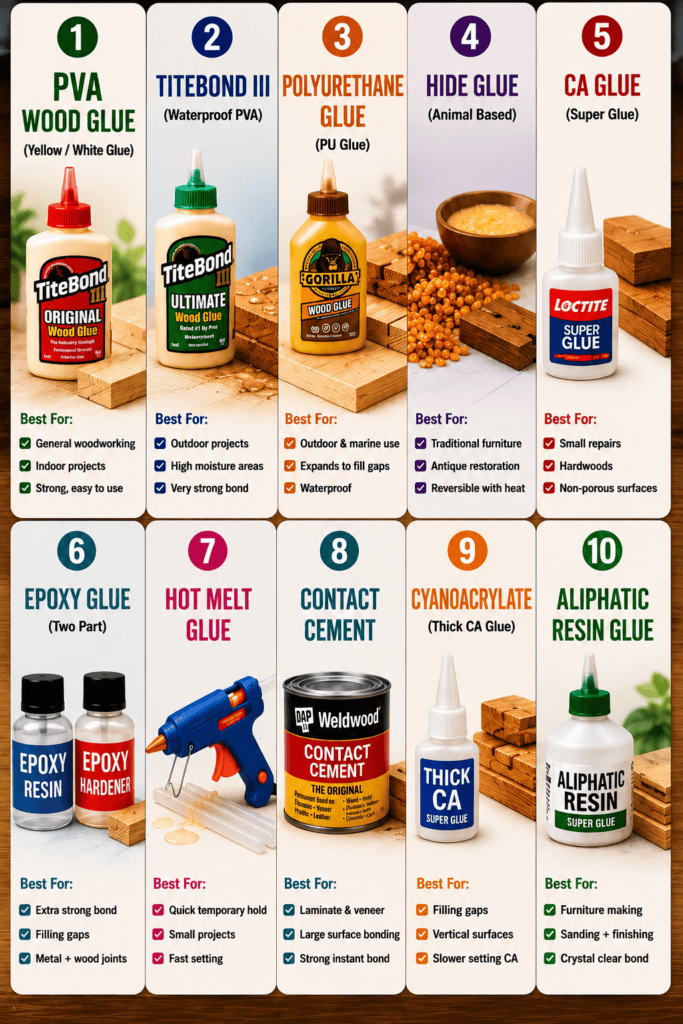
The 10 Types of Wood Glue Explained
Let’s dive into the specifics of each adhesive so you know exactly what to grab for your next glue-up.
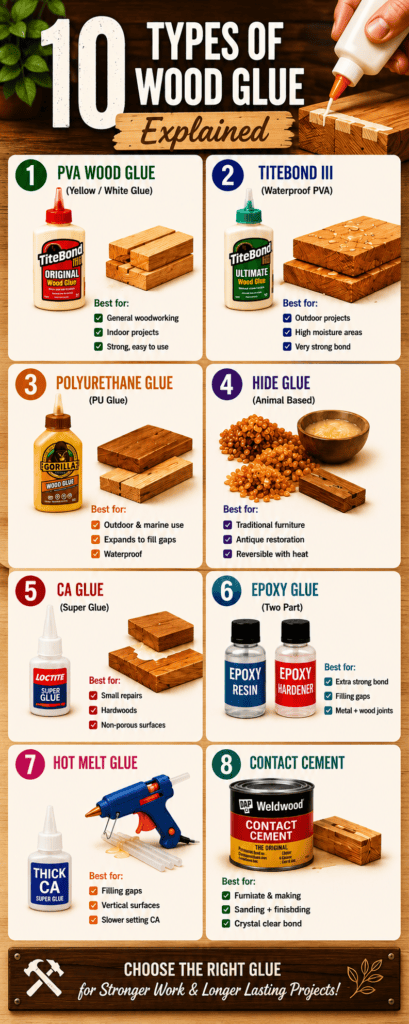
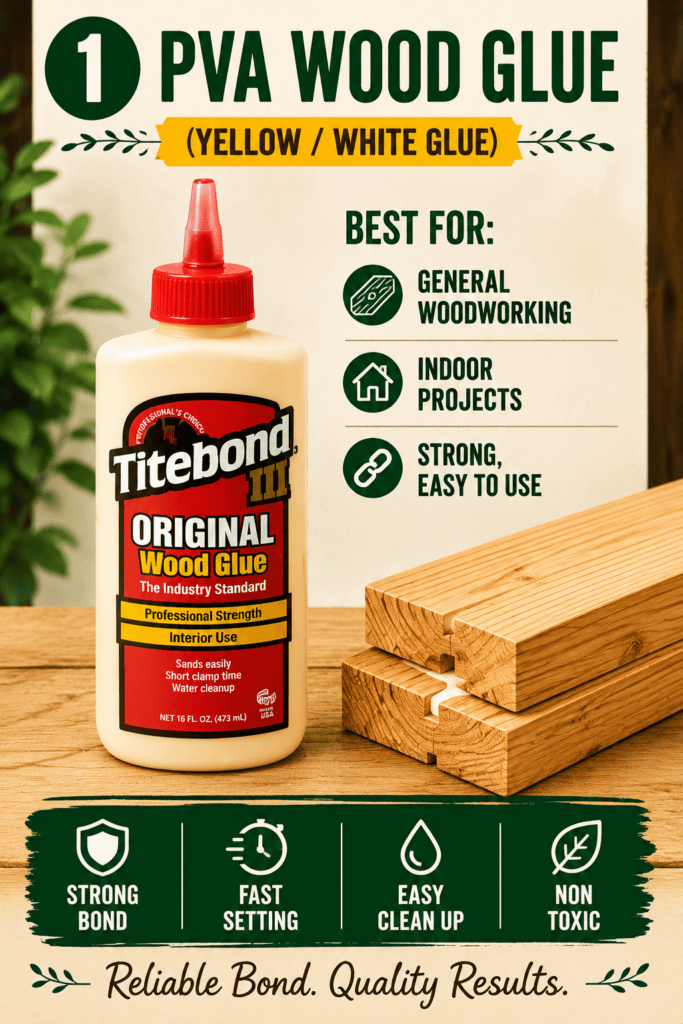
1. Standard PVA Wood Glue (Yellow/White Glue)
The Everyday Workhorse Polyvinyl Acetate (PVA) is the standard glue you’ll find in almost every shop. It’s incredibly easy to use, cleans up with water, and creates a bond that is often stronger than the wood itself.

- Best For: General woodworking, indoor projects, and standard edge-to-edge joints.
- Pros: Very strong, affordable, non-toxic, and easy to clean up.
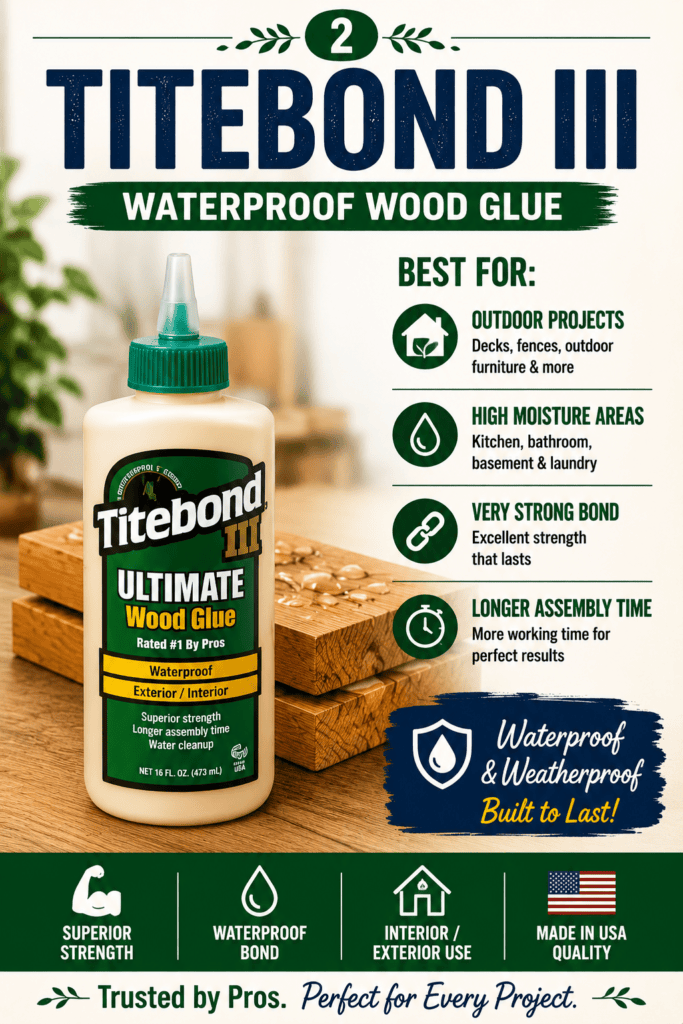
2. Titebond III (Waterproof PVA)
The Outdoor Champion When your project is destined for the patio or the kitchen sink, standard PVA won’t cut it. Titebond III is an advanced PVA formula that is fully waterproof while still offering the easy cleanup of a standard wood glue.
- Best For: Outdoor furniture, cutting boards, and high-moisture areas.
- Pros: Creates a very strong bond, FDA approved for indirect food contact, and gives you a slightly longer open time to assemble complex joints.
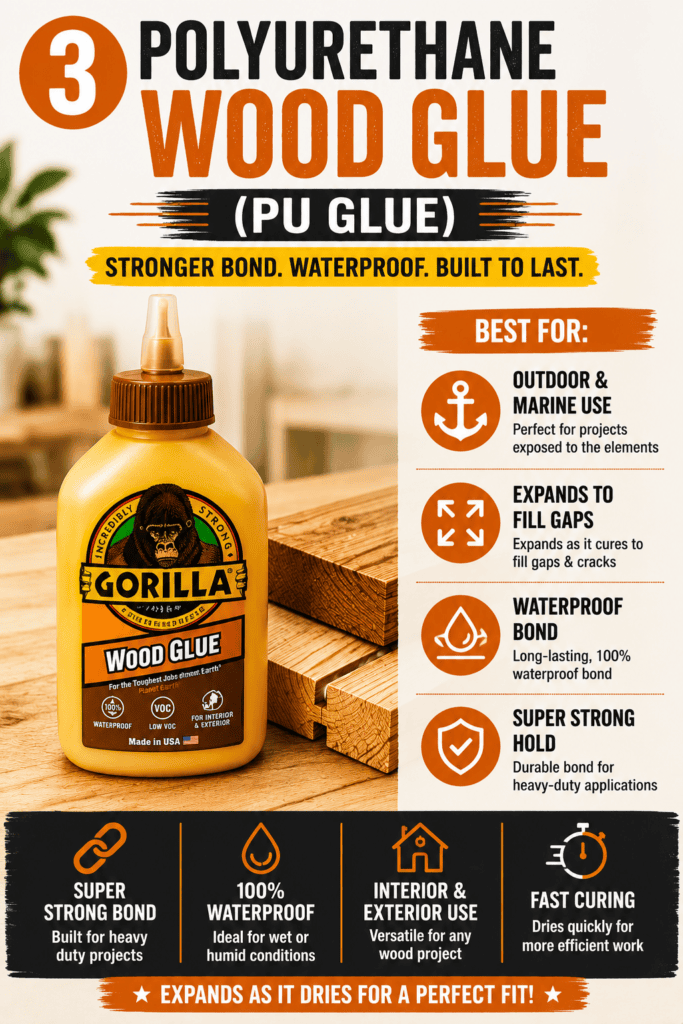
3. Polyurethane Glue (PU Glue)
The Gap Filler Polyurethane glue is unique because it actually requires moisture to cure. As it cures, it expands into a foam, which allows it to push into the wood fibers and fill minor gaps.
🚧 Planning Your Next Build?
Don't start without the Ultimate Guide: Barns, Sheds & Outbuildings. It’s the "DIY Bible" containing:
- 100+ Plans: Barns, sheds, garages, and playhouses.
- Step-by-Step: Covers foundations, framing, wiring, and roofing.
- Blueprints: Includes info on ordering CAD files.
- Best For: Outdoor and marine use, bonding dissimilar materials, and situations where you need gap-filling properties.
- Pros: 100% waterproof and expands to fill imperfect joints. Just be prepared to scrape off the squeeze-out!
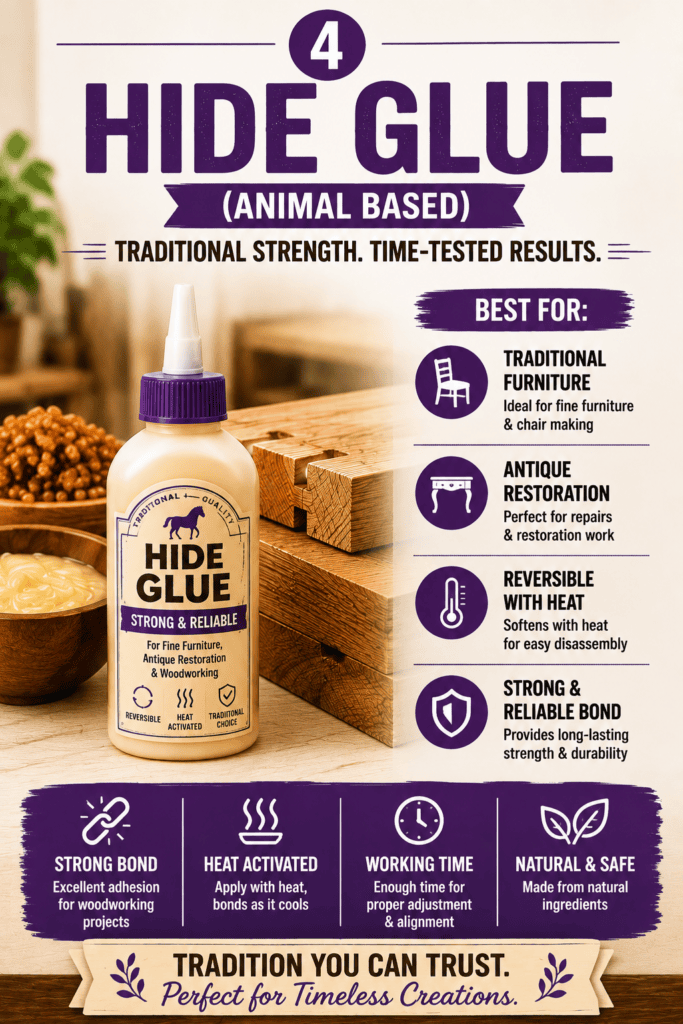
4. Hide Glue (Animal Based)
The Antique Restorer’s Secret Before synthetic plastics, there was hide glue. Traditional woodworkers and luthiers (guitar makers) still swear by it. Its defining characteristic is that it can be reactivated and released with heat and moisture.
- Best For: Traditional furniture making, antique restoration, and musical instruments.
- Pros: Reversible with heat, doesn’t ruin finishes, and sands beautifully.
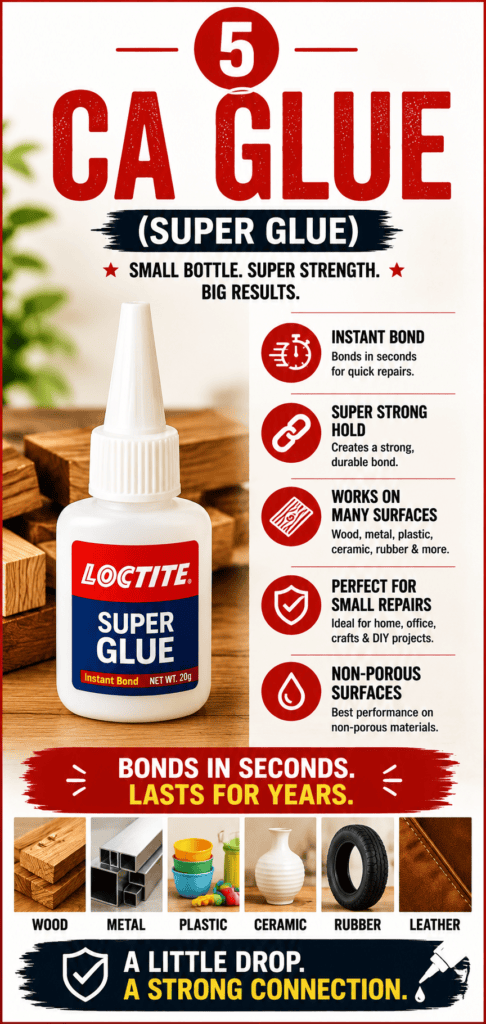
5. Standard CA Glue (Super Glue / Thin)
The Quick Fix Cyanoacrylate (CA) glue is what most of us know as Super Glue. In woodworking, it’s used for quick fixes or holding small parts together while a primary, slower-drying glue cures.
- Best For: Small repairs, bonding hardwoods, and non-porous surfaces.
- Pros: Sets in seconds (especially with an activator spray) and creates a rigid, brittle bond.
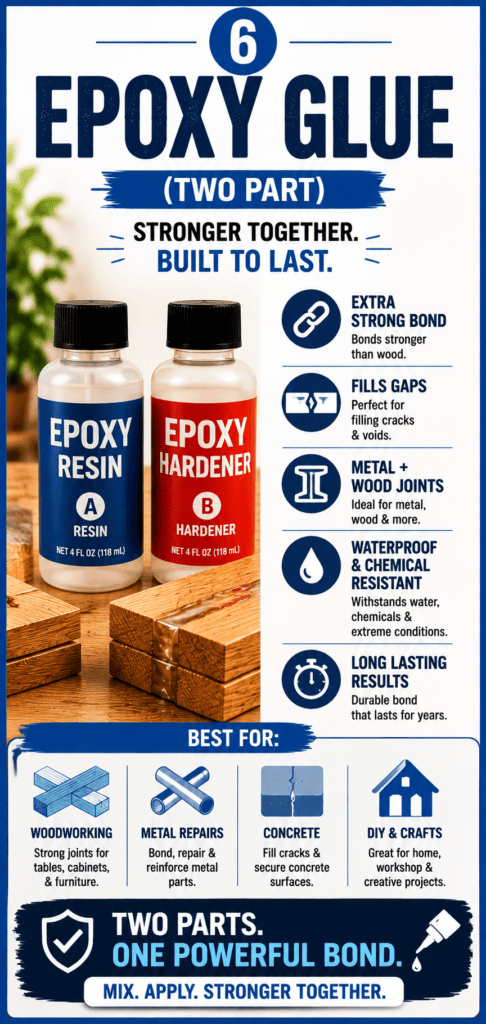
6. Epoxy Glue (Two-Part)
The Heavyweight Lifter When you need the absolute maximum strength possible, or when you are dealing with massive voids (like a river table), two-part epoxy is the undisputed king. You mix a resin and a hardener to trigger a chemical reaction.
- Best For: Extra strong bonds, filling large gaps, and metal-to-wood joints.
- Pros: Incredible structural strength, waterproof, and won’t shrink as it cures.
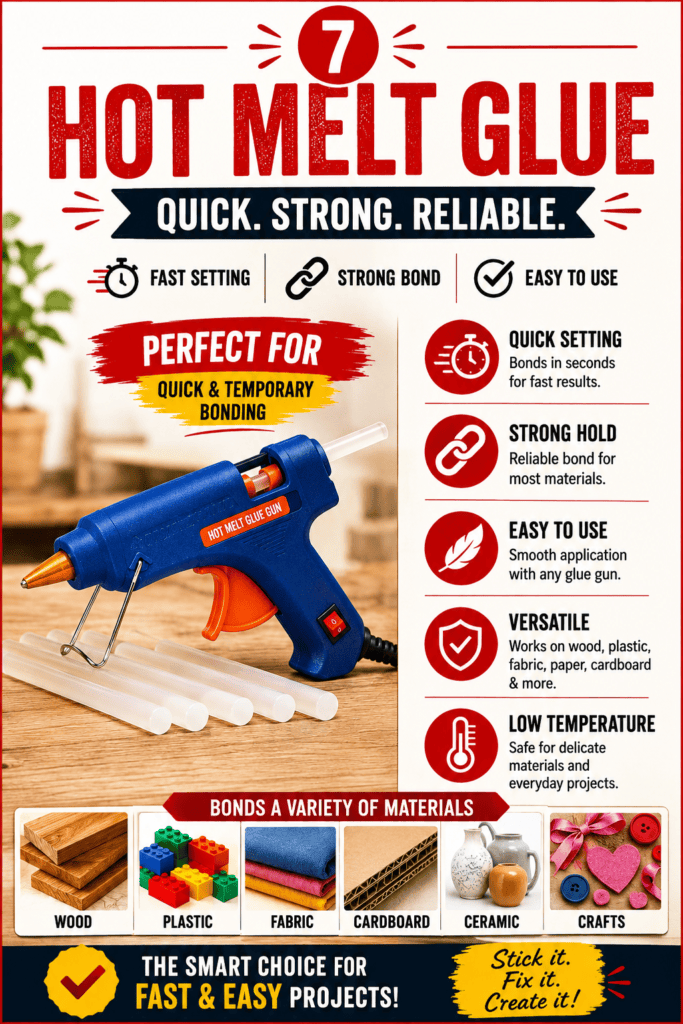
7. Hot Melt Glue
The Jig Builder’s Helper You might associate hot glue with crafts, but it has a place in the woodshop. It is fantastic for temporarily tacking templates to a workpiece or building quick-and-dirty shop jigs.
- Best For: Quick temporary holds, small craft projects, and fast-setting applications.
- Pros: Instant grab, easy to pop loose with a chisel when you’re done.
8. Contact Cement
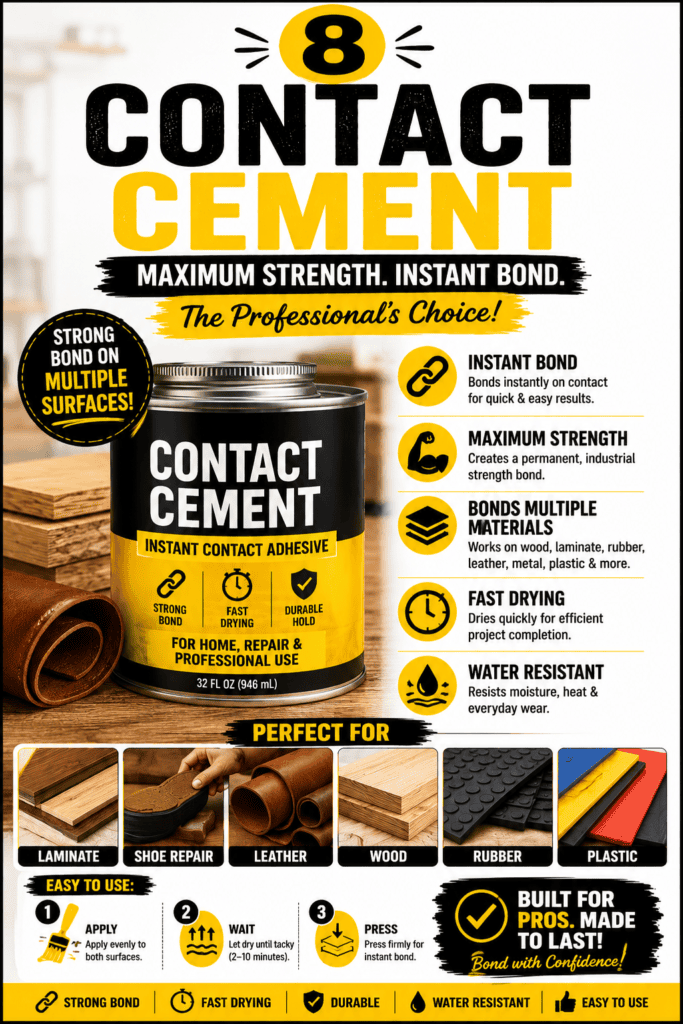
The Laminate Master Contact cement is applied to both surfaces, left to dry until tacky, and then pressed together. The moment the two coated surfaces touch, they bond instantly and permanently.
- Best For: Applying veneers, laminates (like Formica), and large surface bonding.
- Pros: Unbeatable strong instant bond. (Note: You get no second chances to align your pieces!)
9. Cyanoacrylate (Thick CA Glue)
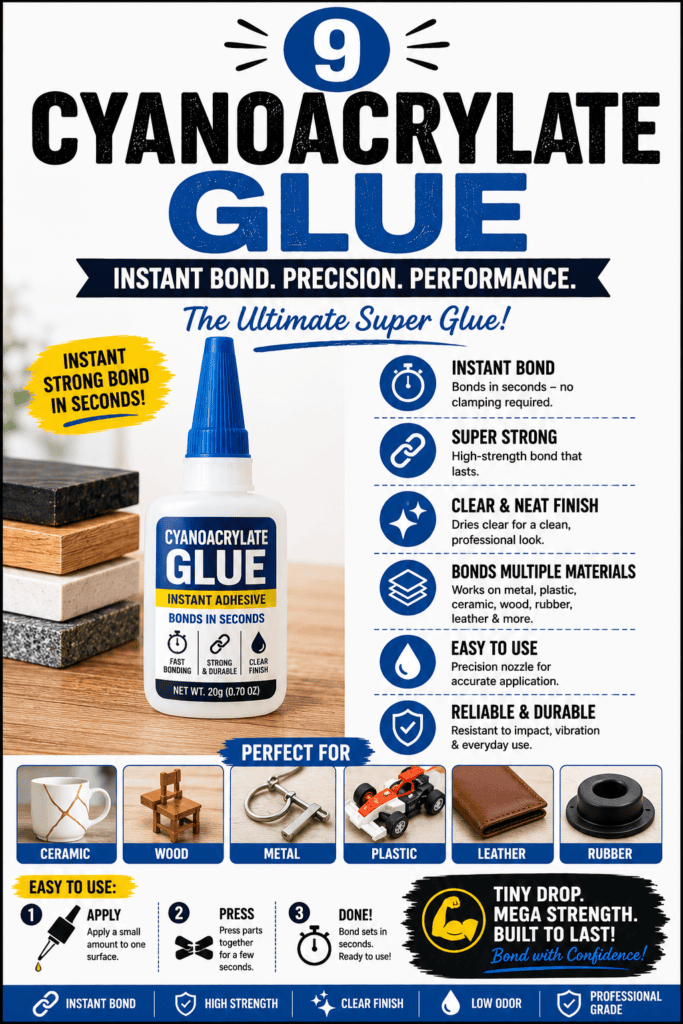
The Vertical Savior Unlike thin CA glue that runs everywhere, thick CA glue stays exactly where you put it. It has a slightly longer open time, allowing for minor adjustments.
- Best For: Filling small gaps, vertical surfaces where drips are an issue, and applications needing a slower setting CA.
- Pros: Excellent control, less messy than thin super glue, and still cures incredibly fast.
10. Aliphatic Resin Glue
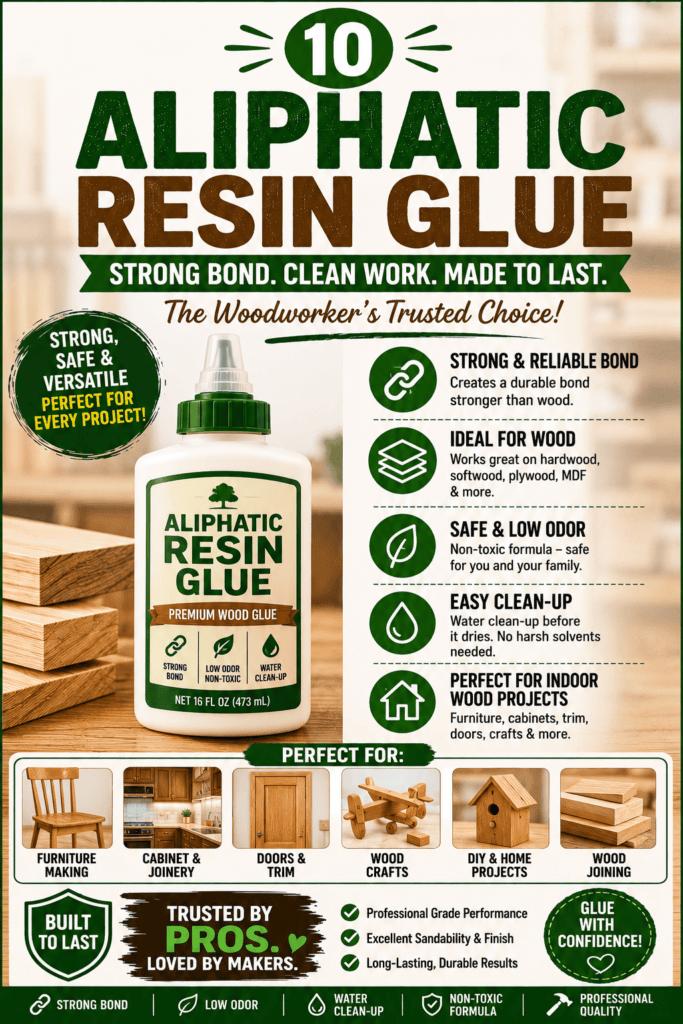
The Finisher’s Friend Often referred to simply as “yellow glue,” aliphatic resin is very similar to PVA but is formulated to dry harder. This makes it much easier to sand without gumming up your sandpaper.
Pros: Sands perfectly crisp and resists “creep” (where joints shift slightly over time).
Best For: Fine furniture making, projects requiring extensive sanding, and achieving a crystal clear bond line.
For general indoor furniture and cabinetry, Standard PVA (Yellow/White Glue) or Aliphatic Resin are your best bets due to their ease of use and strong bonds. For outdoor projects exposed to moisture, you need a waterproof option like Titebond III or Polyurethane (PU) Glue. If you are filling large gaps or bonding wood to metal, a two-part Epoxy offers the absolute strongest, most durable hold.
📊 Wood Glue Strength Comparison
Not all adhesives are created equal. If structural integrity is your top priority, here is how the primary glues stack up in terms of raw bonding strength:
- ⭐⭐⭐⭐⭐ Epoxy: Unmatched structural strength.
- ⭐⭐⭐⭐½ Polyurethane: Extremely strong and durable.
- ⭐⭐⭐⭐½ Titebond III: Top-tier strength for wood-to-wood joints.
- ⭐⭐⭐⭐ PVA Wood Glue: Excellent for 90% of standard applications.
- ⭐⭐⭐⭐ Aliphatic Resin: Equal to PVA, but dries harder.
- ⭐⭐⭐½ Contact Cement: Very strong surface adhesion, but not for structural joints.
- ⭐⭐⭐ Thick CA Glue: Good hold, but can be brittle under shear stress.
- ⭐⭐⭐ Hide Glue: Plenty strong for furniture, but designed to yield under extreme stress to save the wood.
- ⭐⭐ Thin CA Glue: Best for micro-repairs.
- ⭐⭐ Hot Melt Glue: Temporary strength only.
📋 Quick Guide: When to Use What
Save yourself the headache of guessing. Here is a rapid-fire cheat sheet for matching the glue to the job:
- Indoor Furniture & Cabinets: Reach for PVA or Aliphatic Resin.
- Outdoor Projects (Planters, Patio Chairs): You need Titebond III or PU Glue.
- Big Gaps & Uneven Surfaces: Mix up some Epoxy or use PU Glue.
- Quick Repairs & Jigs: Keep CA Glue on hand.
- Veneers & Laminates: Always use Contact Cement.
- Antique & Traditional Work: Stick to historic Hide Glue.
🛠️ Pro Tips for a Perfect Glue-Up
Choosing the right bottle is only half the battle. Your technique dictates how well that glue performs. Keep these golden rules in mind:
- Always clean surfaces before gluing: Dust, oil, and old finish will prevent glue from soaking into the wood pores. A quick wipe with mineral spirits or a final pass with sandpaper is mandatory.
- Use clamps for stronger bonds: Wood glues (especially PVA and Aliphatic) require tight, even pressure to form a proper bond. Don’t starve the joint by squeezing all the glue out, but make sure the wood faces are tightly mated.
- Remove squeeze-out while wet: Once PVA or PU glue cures rock hard, getting it off requires heavy sanding or chiseling, which can ruin your wood. Wipe it with a damp rag (for PVA) or let it get slightly rubbery and slice it off with a chisel.
- Give glue enough cure time: Just because a joint feels dry after an hour doesn’t mean it is fully cured. Always wait at least 24 hours before stressing the joint or putting it through a planer.
- Store glue in a cool, dry place: Heat and freezing temperatures will ruin the chemical makeup of your glue. If your PVA glue has turned chunky and won’t mix, throw it away.
❌ Common Glue-Up Mistakes That Ruin Great Projects
We’ve all made them, but avoiding these common pitfalls will instantly elevate the quality of your work:
- Not cleaning the surface (The glue bonds to the dust, not the wood).
- Using too much or too little glue (Too much makes a mess; too little creates a weak, starved joint).
- Not clamping properly (Uneven pressure leads to skewed angles and weak spots).
- Moving the piece too soon (Patience is a virtue in the woodshop).
- Using the wrong glue for the job (Using indoor PVA on a birdhouse is a recipe for disaster).
- Storing glue incorrectly (Always check the shelf life and consistency before pouring).
By understanding the unique properties of these 10 types of wood glue, you take the guesswork out of your assembly process. Stock your shop smartly, respect the curing times, and your next project will be built to last a lifetime.