
When I first started in the shop, a piece of wood was just a piece of wood. A flat surface. A straight line. It didn’t take long—usually after a spectacular failure with a table leg that twisted like a DNA strand—for me to realize that the visual pattern on the surface is just the tip of the iceberg. What’s happening underneath, the internal geometry of the tree, dictates how that wood will look, how it will move, and how it will perform.
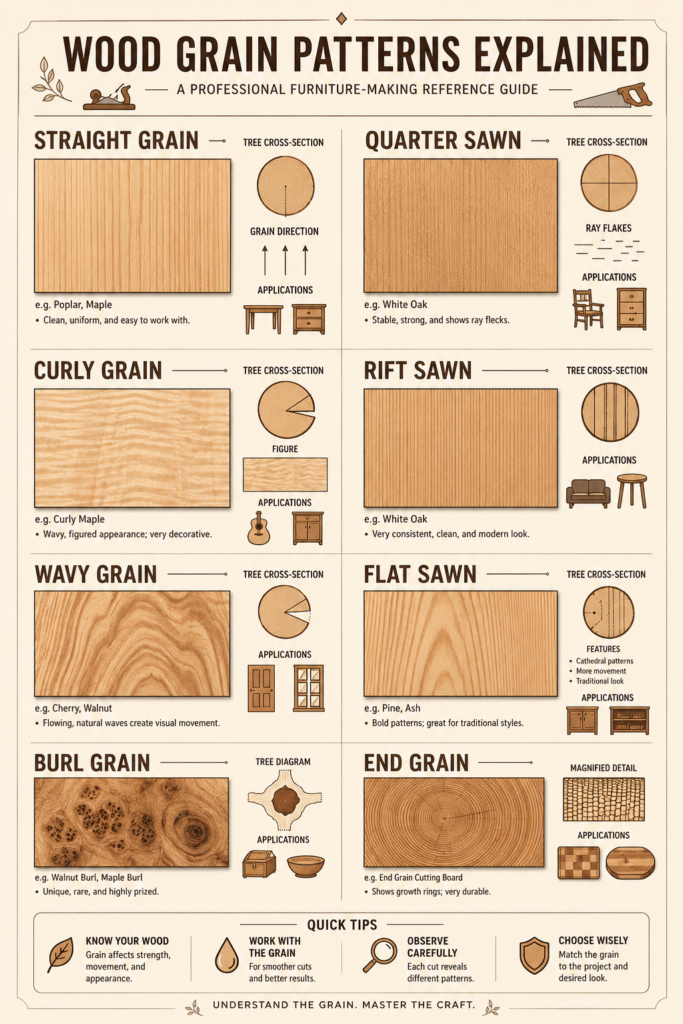
This is your masterclass in decoding the language of the tree. Let’s look beyond the schematic and move into the real, tactile experience of working with six fundamental grain patterns. Forget the old-school charts; I’m taking you into the shop to show you what they actually look like under a tool and in a project.

1. Straight Grain: The Unsung Hero of Predictability
When I’m engineering a complex piece, say, the structural frame of a large cabinet or a set of drawer glides where tolerances are measured in thousands of an inch, I reach for Straight Grain. The original chart shows this as a flat, predictable series of lines. In reality, it’s a canvas of calm.
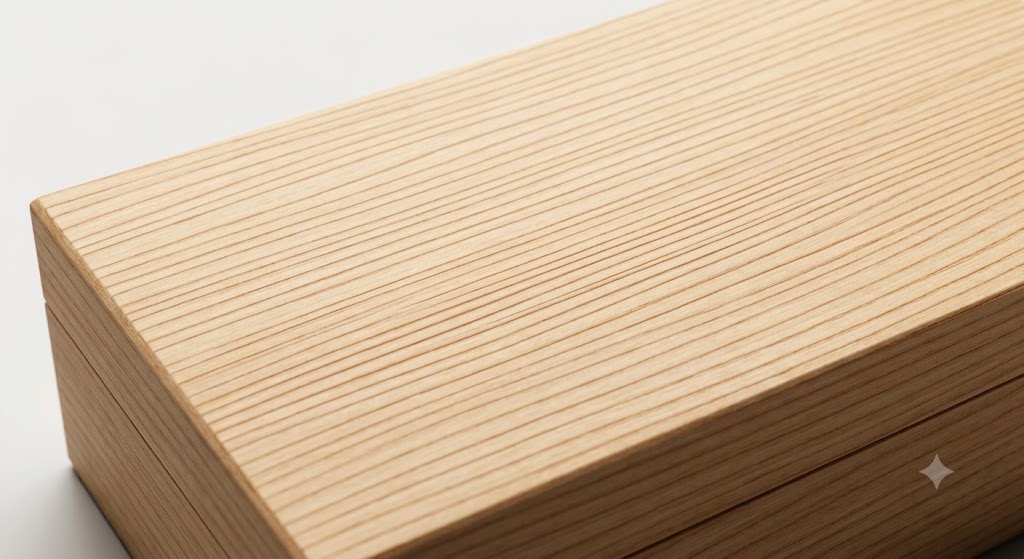
This image presents an extreme close-up of perfectly clear, straight-grained wood, like Maple. The focus is on the parallel, fine lines that offer maximum stability. This specific piece forms the face panel of a precision-machined jewelry box. The clean texture matches the “table legs and drawers” application mentioned in your chart, where minimal movement is key.



You get straight grain from the outermost parts of a log when it’s milled parallel to the bark. Visually, it’s the definition of understated. In my early days, I overlooked it, thinking it ‘boring.’ But my perspective shifted when I built my first massive dining table. The calm, parallel lines allowed the natural luster of the walnut to shine without distraction. Structurally, it’s the most stable cut. Because the grain runs perfectly straight, movement (expansion and contraction) is minimal and uniform. If you want structural integrity and a clean, modernist look, Straight Grain is your foundation.
2. Curly Grain: Chasing the Shimmer
This is the rockstar of grain patterns. The technical term is ‘figured wood,’ and when you see that incredible, undulating wave pattern, you’re looking at what I call ‘Curly’ (or, often, Tiger or Fiddleback) Grain. My first encounter with Curly Maple was purely accidental. I planed a standard-looking board and, as the outer layer came off, a distinct wave appeared. I was hooked.
🚧 Planning Your Next Build?
Don't start without the Ultimate Guide: Barns, Sheds & Outbuildings. It’s the "DIY Bible" containing:
- 100+ Plans: Barns, sheds, garages, and playhouses.
- Step-by-Step: Covers foundations, framing, wiring, and roofing.
- Blueprints: Includes info on ordering CAD files.
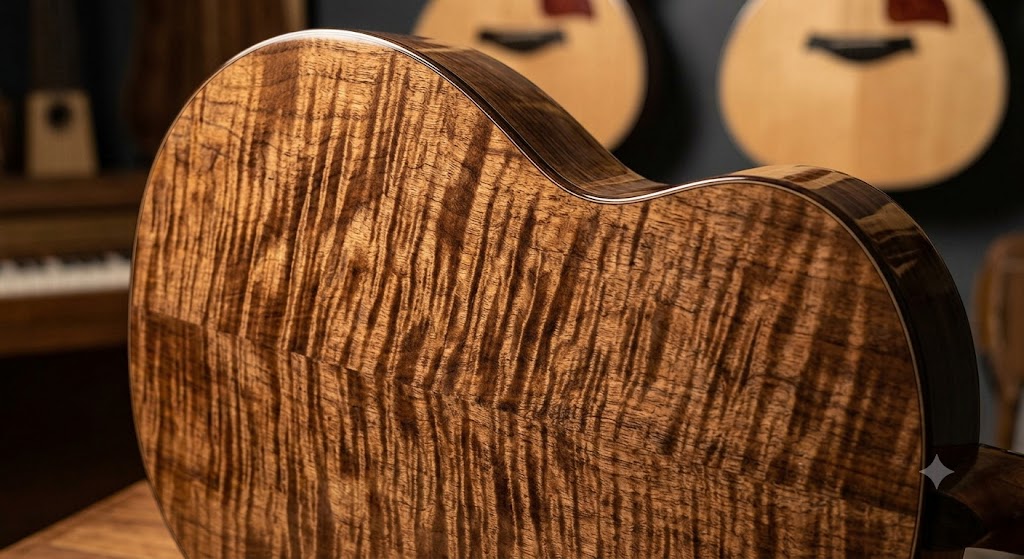
The magic happens when the light hits it. The phenomenon is called chatoyance, which translates to ‘cat’s eye’ effect. It’s not just a visual pattern; it’s a physical ripple in the wood fibers, almost like a 3D illusion. The figure in Figure 2 shows my hands carefully scraping—not sanding—the surface to preserve this texture. It’s hard to work, prone to ‘tear-out,’ and it fights back, but the reward is unparalleled depth. This is the grain you save for statement pieces: instrument bodies, jewelry box lids, or a dramatic high-end veneer panel.
3. Wavy Grain: Nature’s Organic Rhythm
You often find this intermediate grain pattern on panel doors or large architectural millwork. It’s less intense than Curly Grain, offering a gentle, organic rhythm. Instead of a tight wave, the tree has grown in loose, undulating curves. I often find this cut pleasing for surfaces where Straight Grain feels too sterile, but dramatic Curly Grain would overwhelm the eye.

It adds motion and warmth without shouting. It reminds me of gentle water ripples. It’s slightly more difficult to machine than straight grain, requiring a shallow cut to avoid chipping, but it adds a lovely ‘human’ touch to larger built-in furniture.
4. Quarter Sawn: The Architect’s Favorite
If stability is my structural priority, I cut wood differently. The schematic chart shows this as rays shooting out from the center of the tree diagram. In my hands, that translates to the action seen in Figure 3. I select rough-cut lumber (often Oak or Cherry) that has been specifically milled 90 degrees to the growth rings.


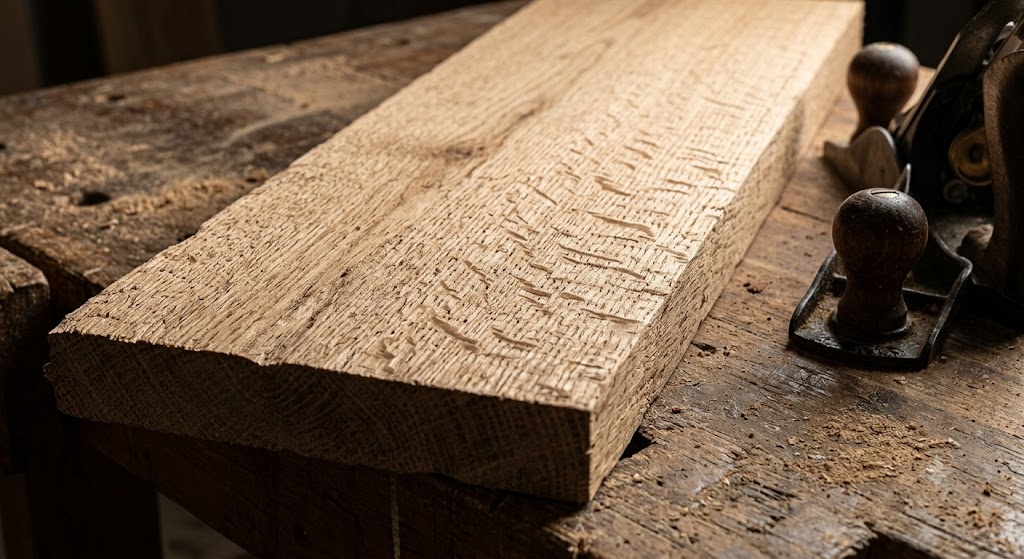
When you plane this wood, you don’t just see parallel lines; you reveal amazing, perpendicular ‘fleck’ or ‘ray flake.’ These are the medullary rays—the tree’s internal nutrient highways. I will never forget my first set of ‘flame-stitch’ Quarter Sawn White Oak boards for a Mission-style chair. It wasn’t just beautiful; that physical structure makes the wood incredibly stiff and virtually immune to warping. It splits less, is wear-resistant (perfect for flooring), and offers unmatched stability for critical structural components.
5. Flat Sawn (Plain Sawn): The Dramatic ‘Cathedral’ Pattern
This is what most people visualize when they think of wood grain. It’s the most common and efficient way to mill a log, cutting tangent to the growth rings. This cut produces dramatic ‘cathedral’ arching patterns.

. Visually, it’s a statement of raw, organic power. I use Flat Sawn stock when I want the raw energy of the wood to take center stage, like on a solid-wood headboard or a large tabletop where the ‘grain story’ is the design. However, and this is crucial, it is the least stable cut. The wide-arcing pattern means that different sections of the board expand at radically different rates, leading to significant cupping. I have learned to respect this cut, ensuring I use extensive joinery and allow for significant wood movement in my designs.
6. End Grain: A Microscopic World
Finally, we arrive at the End Grain. If Figure 1 is the serene surface, Figure 4 is the complex, geometric cellular structure revealed. This isn’t just a surface; it’s a map of the tree’s life, shown at the cellular level. When you cut a log perpendicular to its length, you expose the tree’s pores and annual rings.

The technical chart lists ‘Butcher Block’ as an application, and in Figure 4, you can see why. That pattern of circular cross-sections means you are striking the toughest part of the fiber—the end of the straw, so to speak. This makes End Grain surfaces incredibly resilient to impact. It’s self-healing; knives slide between fibers rather than severing them, which is why your best cutting boards are always End Grain. When I finish a massive End Grain block, I spend more time staring at the intricate, microscopic geometry than any other part of the build. It’s truly humbling.
Understanding these grains isn’t just about identifying patterns from a schematic; it’s about understanding the language and physics of the material. When you choose your grain, you are choosing your stability, your visual language, and how you must interact with the tool. Get in the shop, try planning these different cuts, and experience the ‘chatoyance‘ and ‘ray flake‘ yourself. That is where real expertise is built.
Frequently Asked Questions (FAQ)
Q: What is the most stable wood cut for building furniture?
A: Quarter Sawn is widely considered the most structurally stable cut. Because it is milled at a 90-degree angle to the growth rings, it is incredibly stiff, wear-resistant, and virtually immune to warping. Straight Grain is also a highly stable and predictable choice for structural frames where minimal movement is essential.
Q: What is “chatoyance” in woodworking?
A: Chatoyance is a striking optical phenomenon, often referred to as the “cat’s eye” effect. Commonly found in highly figured woods like Curly Grain (e.g., Curly Maple or Walnut), it is a physical ripple in the wood fibers that catches the light, creating a deep, shimmering 3D illusion across the surface.
Q: Why are the best butcher blocks made from end grain?
A: End Grain is cut perpendicular to the log’s length, exposing the tree’s dense pores and annual rings. This orientation means you are cutting against the toughest part of the fiber. It is highly resilient to impact and naturally “self-healing,” as knife blades slide smoothly between the vertical fibers rather than severing them.
Q: Which wood grain pattern is the most likely to warp or cup?
A: Flat Sawn (or Plain Sawn) wood is generally the least stable cut. While it produces stunning, dramatic “cathedral” arching patterns, the wide-arcing rings mean different sections of the board expand and contract at radically different rates, making it prone to significant cupping if not joined properly.
Q: What are the bright flecks visible in Quarter Sawn oak?
A: Those striking silver flecks are called medullary rays (or “ray flake”). They are the tree’s internal nutrient highways. Miling the lumber at a precise 90-degree angle to the growth rings reveals this beautiful, perpendicular internal structure, which is a hallmark of traditional Mission-style furniture.
Q: What is the difference between Curly Grain and Wavy Grain?
A: Both are considered “figured” woods, but they differ in intensity. Curly Grain features tight, undulating waves with intense chatoyance, making it ideal for small statement pieces like instruments. Wavy Grain has looser, broader undulating curves that offer a gentler organic rhythm, making it better suited for large architectural millwork and panel doors without overwhelming the eye.